
La publicación contiene entrevistas, artículos científicos y noticias propias de la sociedad de interés para todos sus socios.
En los últimos meses, ASEICA ha firmado varios acuerdos de colaboración con diferentes Sociedades Científicas con el objetivo de favorecer la creación de un espacio de trabajo común.
[su_custom_gallery source="media: 2677,2676,2675,2674,2673,2672,2671,2670,2669,2668,2667,2666,2665,2664,2663,2662,2661,2660,2659,2658,2657,2656,2655,2654,2653,2652,2651,2650,2649,2648,2647,2646,2645,2644,2643,2642,2641,2640,2639,2638,2637,2636,2635,2634,2633,2632,2631,2630,2629,2628,2627,2626,2625,2624,2623,2622,2621,2620,2619,2618,2617,2616,2615,2614,2613,2612,2611,2610,2609,2608,2607,2606,2605,2604,2603,2602,2601,2600,2599,2598,2597,2596,2595,2594,2593,2592,2591,2590,2589,2588,2587,2586,2585,2584,2583,2582,2581,2580" limit="95" title="never"]
The researchers, led by David Llobet-Navas from the Institute of Genetic Medicine at Newcastle University and with support from collaborators at Institute of Biomedical Research Lleida and the Bellvitge Biomedical Research Institute (IDIBELL) in Barcelona, report on their findings in Autophagy.
Endometrial cancer
Endometrial cancer is the most common gynaecological malignancy in women that appears in the inner lining of the uterus. Abnormal bleedings represent the main cause of diagnosis of EC, which is often found at early stages and confined within the womb. In these cases primary surgery is often curative. Unfortunately, 15-20% of early-stage cases recur after surgery and patients need to be treated with radiation therapy, chemotherapy, or both. Patients diagnosed with more advanced forms of the disease are also provided with these standards of care.
Treatment failure, defined as recurrence or overt dissemination (metastasis), is unfortunately common and made worse by the unavailability of established second line treatments. As a consequence, the prognosis of patients with recurred or metastatic endometrial cancer is poor with median survival rates of less than one year.
Autophagy protects endometrial cancer cells against targeted agent
Over the last years, our knowledge about autophagy (a cellular process in which cells degrade their own structures in order to obtain energy and to face nutrient starvation) has increased considerably and their discoverers have recently been awarded with the 2016 Nobel Prize.
The study by Dr Llobet-Navas and colleagues describes how endometrial cancer cells resist treatment using the anticancer compound sorafenib, a broad-spectrum kinase inhibitor and antiangiogenic agent, by inducing autophagy. By linking molecular biology, systems biology and avatar models the study describes how sorafenib activates the stress signalling molecules MAPK/JNK that will, in turn, trigger protective autophagy.
The results of this study provide insights on why sorafenib exhibited modest effects in clinical trials for endometrial cancer patients and has important clinical implications since no targeted therapies have been implemented in this malignancy so far. The authors postulate that autophagy inhibition could potentially be used as a therapeutic approach in combination with sorafenib in recurred or metastatic endometrial cancer patients.
Reference: Autophagy orchestrates adaptive responses to targeted therapy in endometrial cancer. Nuria Eritja, Bo-Juen Chen, Ruth Rodriguez-Barrueco, Maria Santacana, Sonia Gatius, August Vidal, Maria Dolores Marti, Jordi Ponce, Laura Bergada, Andree Yeramian, Mario Encinas, Joan Ribera, Jaume Reventos, Jeff Boyd, Alberto Villanueva, Xavier Matias-Guiu, Xavier Dolcet, David Llobet-Navas. Autophagy. doi: 10.1080/15548627.2016.1271512
Apreciado/a socio/a,
Como nuevo presidente de ASEICA en primer lugar quisiera agradecerte, en nombre de la Sociedad, tu pasión por la investigación y tu esfuerzo personal.
Los socios de ASEICA compartiremos y renovaremos en estos días, una vez más, el deseo de lograr la excelencia en la investigación oncológica y de poder ofrecer nuestros resultados en aplicaciones para mejorar la supervivencia en esta cruel enfermedad y así poder conseguir un futuro mejor para el paciente con cáncer. Por nuestra parte dedicaremos todos nuestros esfuerzos para hacer este deseo una realidad, y para ello necesitamos contar con tu colaboración.
ASEICA debe posicionarse como un elemento decisivo en la investigación del cáncer en España, debe ser su referencia, y tendremos que lograr ser una Sociedad con la capacidad para ofrecer los recursos necesarios para atender las necesidades formativas y oportunidades del investigador en España. La Investigación en Cáncer debe ser una demanda social y a ello vamos a dirigir nuestros esfuerzos.
En el nombre de la Junta Directiva y en el mío propio, queremos hacerte llegar nuestros mejores deseos para que el 2017 te depare grandes momentos personales y profesionales.
Dr. Carlos Camps
Presidente de ASEICA
Junta Directiva ASEICA
Dr. Xosé R. Bustelo | Dra. Noemí Reguart | Dr. Arkaitz Carracedo | Dr. Jesús Paramio | Dra. Angélica Figueroa | Dra. Gema Moreno | Dr. Héctor Peinado | Dra. María S. Soengas | Dr. José Palacios | Dr. Rafael López
Como nuevo presidente de ASEICA en primer lugar quisiera agradecerte, en nombre de la Sociedad, tu pasión por la investigación y tu esfuerzo personal.
Los socios de ASEICA compartiremos y renovaremos en estos días, una vez más, el deseo de lograr la excelencia en la investigación oncológica y de poder ofrecer nuestros resultados en aplicaciones para mejorar la supervivencia en esta cruel enfermedad y así poder conseguir un futuro mejor para el paciente con cáncer. Por nuestra parte dedicaremos todos nuestros esfuerzos para hacer este deseo una realidad, y para ello necesitamos contar con tu colaboración.
ASEICA debe posicionarse como un elemento decisivo en la investigación del cáncer en España, debe ser su referencia, y tendremos que lograr ser una Sociedad con la capacidad para ofrecer los recursos necesarios para atender las necesidades formativas y oportunidades del investigador en España. La Investigación en Cáncer debe ser una demanda social y a ello vamos a dirigir nuestros esfuerzos.
En el nombre de la Junta Directiva y en el mío propio, queremos hacerte llegar nuestros mejores deseos para que el 2017 te depare grandes momentos personales y profesionales.
Dr. Carlos Camps
Presidente de ASEICA
Junta Directiva ASEICA
Dr. Xosé R. Bustelo | Dra. Noemí Reguart | Dr. Arkaitz Carracedo | Dr. Jesús Paramio | Dra. Angélica Figueroa | Dra. Gema Moreno | Dr. Héctor Peinado | Dra. María S. Soengas | Dr. José Palacios | Dr. Rafael López
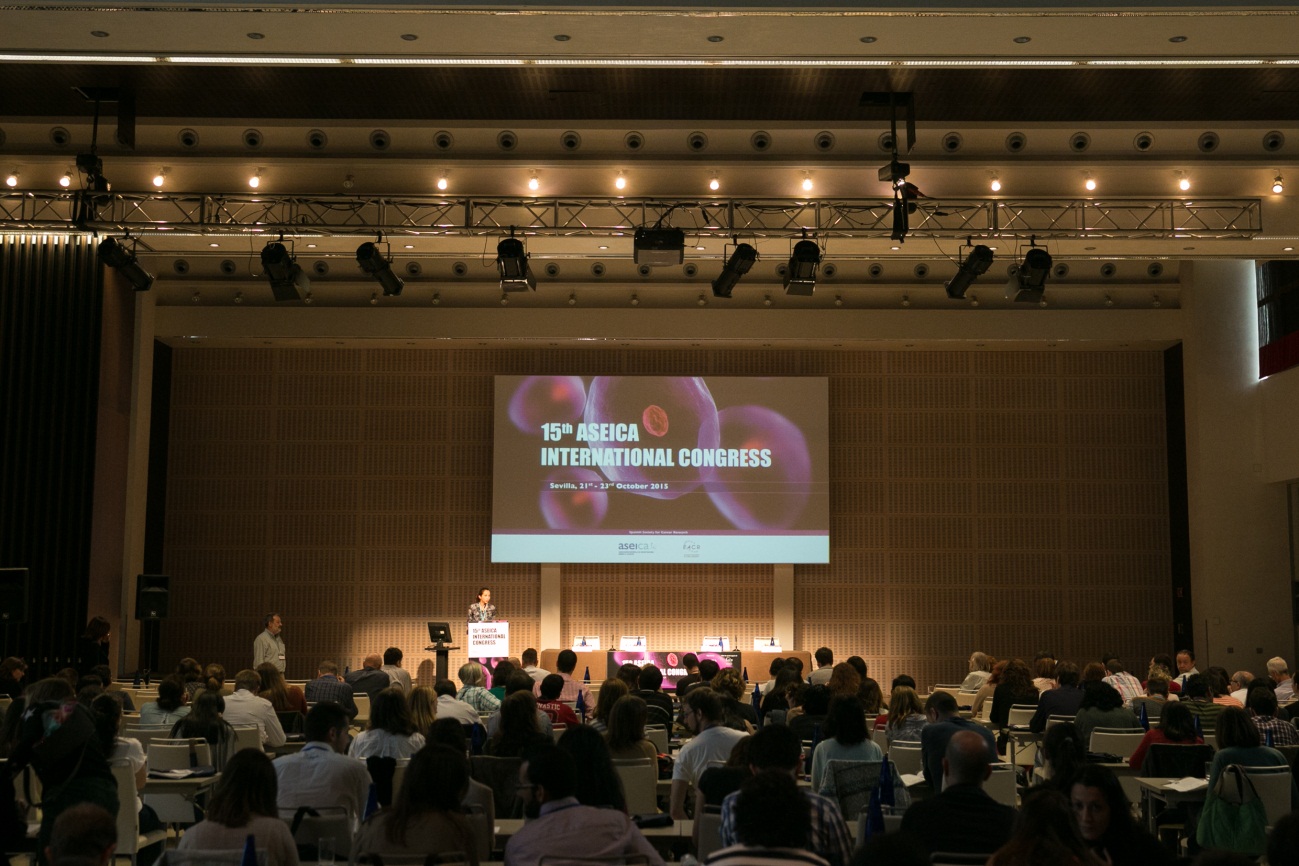
ASEICA celebró el pasado mes de octubre la decimoquinta edición de su congreso bianual. El encuentro contó con la participación de 40 ponentes y reunió a más de 250 especialistas de la oncología básica y la clínica.
Durante el congreso también se entregó el “1st ASEICA Cancer Research Award” y el “1st ASEICA Young Investigator Award”.

Durante el congreso también se entregó el “1st ASEICA Cancer Research Award” y el “1st ASEICA Young Investigator Award”.
El Cáncer y la Investigación Biomédica en España, en una encrucijada
- La Asociación Española de Investigación sobre el Cáncer (ASEICA) solicita una inversión consensuada, adecuada y a largo plazo en I+D+i en los presupuestos generales del estado, que permita garantizar el progreso de la investigación biomédica en general, y de la oncológica en particular.
- Ante el anuncio de la creación de la Agencia Estatal de Investigación, ASEICA entiende que el Instituto de Salud Carlos III (ISCIII) y Fondo de Investigaciones Sanitarias (FIS) deben mantener su independencia, siendo capaces de diseñar, coordinar y dirigir de manera autónoma la investigación biomédica.
La investigación de hoy para el beneficio del mañana. Los avances científicos de los últimos años han generado grandes expectativas en el control y manejo de las enfermedades. La investigación traslacional biomédica, cuyo motor es la colaboración entre los profesionales de la investigación básica y la clínica, ha dado también un importante salto cuantitativo y cualitativo en la última década en nuestro país.
Este nuevo conocimiento ya está revolucionando la práctica asistencial con la llegada de la Medicina de Precisión, que permite individualizar el manejo de los pacientes. La Oncología es uno de los campos donde esta nueva medicina está llegando con mayor rapidez, beneficiando a un mayor número de enfermos.
La investigación es una carrera de largo recorrido cuyo beneficio siempre es evidente a largo plazo. Desde ASEICA creemos que la investigación biomédica debe ser afrontada como un asunto de estado, con una financiación consensuada, adecuada y estable, no sujeta a las visiones políticas cortoplacistas. Es necesario incrementar el porcentaje del PIB destinado a I+D+i para permitir que los investigadores de diferentes disciplinas, en colaboración con la administración y la industria farmacéutica, continuemos aunando nuestros esfuerzos, energías y conocimientos para combatir los problemas reales de los enfermos.
El ISCIII, una pieza clave en la investigación del cáncer en España
El Instituto de Salud Carlos III (ISCIII) es el principal Organismo Público de Investigación (OPI), que financia, gestiona y ejecuta la investigación biomédica en España. Adscrito a los Ministerios de Economía y Competitividad (MINECO) y de Sanidad, Servicios Sociales e Igualdad (MSSSI), promueve la generación de conocimiento científico en ciencias de la salud e impulsa la innovación en la atención sanitaria y en la prevención de la enfermedad.

ASEICA entiende que la creación de una Agencia Estatal de Investigación (AEI) puede ser útil para promover y facilitar la coordinación e integración de la investigación española. Solicitamos que este proceso de cambio se lleve a cabo bajo la premisa de una total transparencia, haciendo a los investigadores biomédicos conocedores de las características y las ventajas que podría suponer la creación de la AEI. En concreto, consideramos que la creación de esta Agencia no debe mermar la actual capacidad del ISCIII y del FIS para diseñar, coordinar y dirigir de manera autónoma la investigación biomédica. La actividad investigadora, en visión de ASEICA, debe ser de máxima calidad científica así como de indudable relevancia médica en sus distintas facetas.
Solicitamos a las autoridades que la reorganización que se propugna vaya acompañada de una recuperación substancial de los presupuestos destinados a investigación en general, y a la investigación biomédica en particular. Finalmente, desde ASEICA apoyamos la creación de un grupo de trabajo con el objetivo de diseñar qué papel jugará la AEI en el ámbito de la salud, formado por los Institutos de Investigación Sanitaria, el Instituto Carlos III, el Ministerio de Sanidad y la propia Secretaría de Estado de I+D+i, de manera que se evite la desaparición del ISCIII y de una de sus principales herramientas, el FIS (actual Subdirección General de Promoción y evaluación de la Investigación).
Barcelona, 20 de mayo de 2015
Sobre ASEICA
La Asociación Española de Investigación sobre el Cáncer (ASEICA) es una sociedad científica que nace en el año 1983 con el objetivo de promover la investigación del cáncer y la divulgación científica entre los profesionales dedicados a la oncología.
Con una perspectiva traslacional, ASEICA se ha convertido en un punto de encuentro entre investigadores básicos y clínicos que incentiva la interacción de ambas partes con el fin último de encontrar las mejores soluciones para el abordaje de la enfermedad.
Junta Directiva ASEICA
Pedro A. Lazo-Zbikowski
Carlos Camps
Noemí Reguart
Gabriel Capellá
Montserrat Sánchez
Luis Paz-Ares
Ana Osorio
Arkaitz Carracedo
Jesus M. Paramio
José Palacios